
Work From Home Stress vs Office Stress: 5 Real Differences
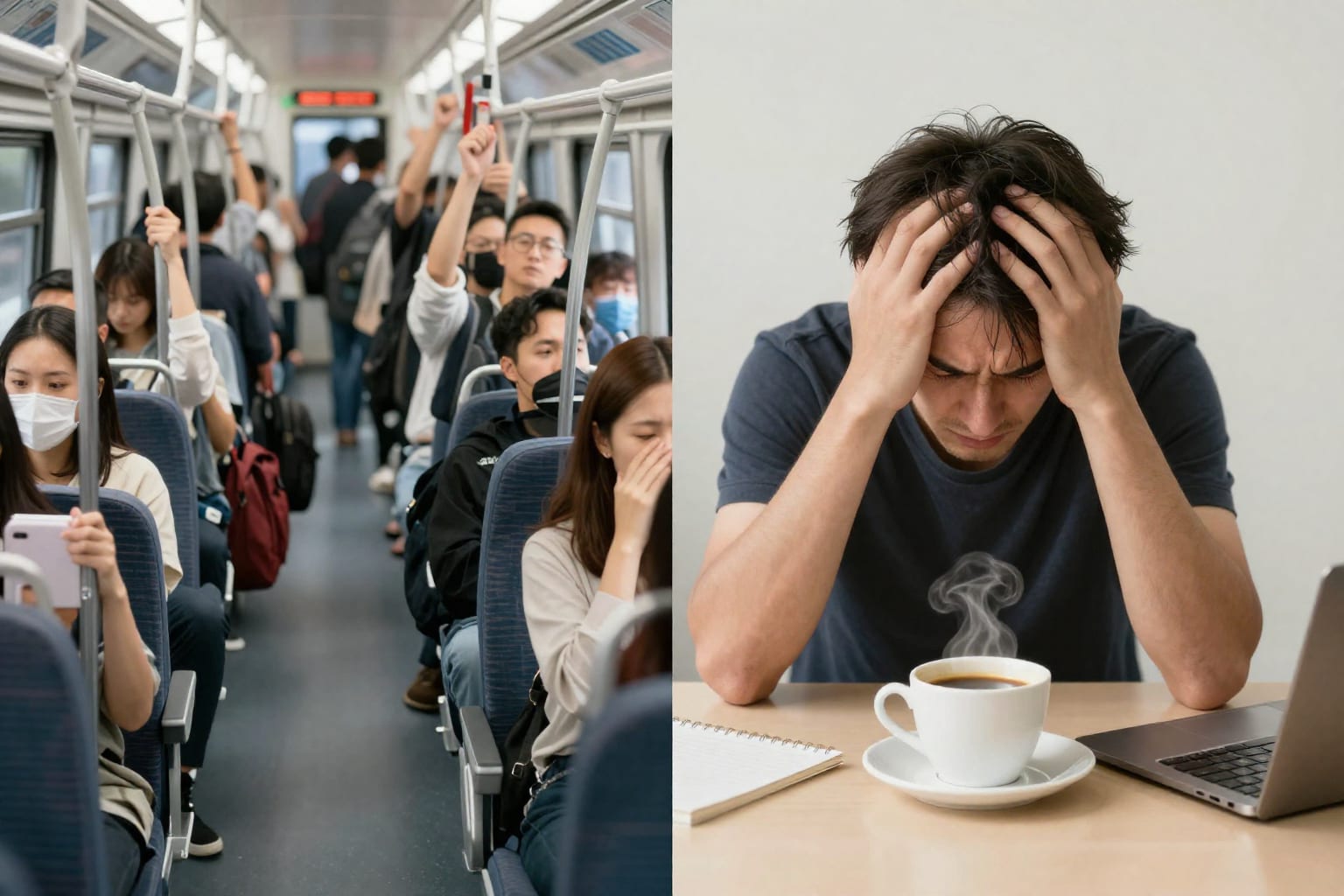
I have worked from home for three years and in an office for seven. I have felt the specific dread of a 7:45 AM train platform and the vague unease of a silent apartment at 4 PM on a Tuesday. Both settings produce real stress, but work from home stress vs office stress key differences are not just about location—they are about what kind of mental weight you carry. After a decade of experiencing both, I have identified five real differences that shape how your brain reacts to each environment. Here is what I have learned, and what might help you understand your own stress better.
The Commute Cost: How Travel Time Transforms Your Stress
When I worked in an office, my day started with a 45-minute drive. That sounds like a wind-down buffer, but it was actually a cortisol spike. I would sit in traffic, check my phone, and arrive already tight-shouldered. The American Psychological Association links commute time to higher stress and lower well-being. In contrast, my WFH mornings begin with a slow pour-over coffee and ten minutes of quiet. The difference is physiological: the commute forces an abrupt transition from home to work mode, while a home start lets you ease in. That 45-minute loss of control—waiting for a late bus, hitting every red light—is a stress cost office workers pay daily. WFH removes that cost entirely, but it also removes the mental transition. You trade a stressful commute for a potentially stressful lack of separation.
The Hidden Cortisol Spike of Rush Hour
Rush hour is not just annoying; it is a biological stressor. Your body releases cortisol in response to perceived threats—and being stuck in traffic, late, or in a crowd triggers that response. A 2023 study found that longer commutes are associated with higher cortisol levels. In the office, that spike can linger into your first hour of work. At home, you skip that spike. But here is the flip side: without the commute, you also skip the decompression. I used to use my drive home to listen to music and mentally close the workday. Now I have to deliberately create that wind-down. The stress is different—less acute, but more chronic if you do not manage boundaries.
Social Isolation vs. Overstimulation: The People Problem
I once thought I hated people. Then I worked from home for six months and realized I actually missed them—just not all day, every day. This is the core tension. In the office, you are constantly around others: the chatter, the interruptions, the smell of someone's microwave popcorn. That can be overstimulating. Open-plan offices are linked to higher stress and lower focus. But at home, the silence can be deafening. I have gone three full days without a meaningful face-to-face conversation. That isolation is its own stressor—it feels like being adrift. The office gives you a social buffer; colleagues can distract you from work stress. At home, you are alone with your to-do list. Neither is better; they just hurt differently.
The Quiet Despair of No Colleagues
When I first started remote work, I celebrated the quiet. But after a few months, I noticed a creeping loneliness. There was no one to turn to and say, 'Can you believe that email?' The lack of casual interaction is a real stress. Harvard Business Review has reported that remote workers often feel disconnected and unsupported. That absence of a social safety net can make small problems feel huge. I have had days where a minor misunderstanding with a client spiraled in my head because I had no colleague to talk it through with. The office provides that informal support. At home, you have to actively seek it, which takes energy you might not have.
The Open-Plan Overload That Never Ends
On the flip side, the office can be a sensory assault. In my old open-plan office, I could hear three conversations at once, the printer, and someone's phone ringing. That constant noise is a stressor. Research from the University of California, Irvine, shows that interruptions can increase stress and frustration. I would leave some days with a headache and a sense of never having had a single uninterrupted thought. At home, I can control the noise. But that control comes with responsibility—I have to enforce quiet, which is its own kind of mental load.
Blurred Boundaries: When Your Home Becomes a 24/7 Office
The biggest surprise of WFH for me was how hard it is to stop working. In the office, you leave at 5 PM, and the building is no longer your concern. At home, the laptop is always there. I have caught myself answering emails at 9 PM, then feeling guilty about not doing more. That blurred boundary is a primary source of WFH stress. The office forces a physical separation that makes mental separation easier. At home, you have to create that line yourself—and if you fail, you are always on the clock. That chronic, never-off feeling can lead to burnout faster than a busy but contained office day.
The Endless Workday Trap
I used to think I was being productive by working late. In reality, I was just anxious. The lack of a commute means no natural transition. Psychologists call this 'work-leakage'—work thoughts seeping into personal time. In the office, you have a commute, a building exit, a ritual. At home, you close the laptop, but the room is still your living room. That can make it feel like you can never truly clock out. I have had to train myself to do a closing ritual: shut the laptop, put it in a drawer, and take a walk. Without it, the stress of the workday follows me into the evening.
Control Over Your Environment: The Untold Stress Factor
In the office, you have little control over your environment. The thermostat is set by someone else, the lighting is fluorescent, and the chair might be ergonomic but not to your preferences. That lack of control is a stressor. The National Institute for Occupational Safety and Health (NIOSH) has found that low control over work environment is associated with higher stress. At home, you have full control—which sounds great, but it also means full responsibility. I have spent hours agonizing over desk height, monitor placement, and internet speed. That pressure to create the 'perfect' setup can be exhausting. In the office, you just sit down and work. At home, you are the facilities manager, IT support, and ergonomics consultant.
Office: The Frustration of Shared Spaces
I remember one winter when the office thermostat was set to 65°F. I wore a jacket all day. I could not change it. That small lack of control built up over weeks. Other annoyances—the loud typing, the flickering light—became stress triggers because I could not fix them. That frustration is a real cost of office work. You trade autonomy for convenience.
Home: The Pressure to Create Your Own Setup
At home, the pressure is different. I spent three months with a dining chair that hurt my back before I finally bought an ergonomic one. The decision fatigue of buying equipment, setting up a space, and troubleshooting Wi-Fi is real. And if something breaks—like my internet went out during a video call—there is no IT desk to call. You are on your own. That responsibility can feel heavy, especially if you are not naturally handy. The stress is about ownership, not frustration.
The Invisible Productivity Pressure: Being Watched vs. Being Invisible
This is the difference that surprised me most. In the office, you are visible. Your manager can see you working, or not working. That creates a pressure to look busy—even when you are not. It is a form of surveillance that can spike anxiety. At home, you are invisible. No one can see you. But that invisibility creates its own pressure: the fear that others think you are not working. I have found myself sending emails at odd hours just to prove I was online. That productivity anxiety is different—it is about signaling, not performing. In the office, you are stressed about being watched. At home, you are stressed about not being seen.
The Panic of Being 'Seen' in the Office
I once had a manager who would walk past my desk every hour. I felt like I had to look busy even when I was thinking. That constant visibility can make you feel micromanaged. Research suggests that perceived surveillance increases stress and reduces job satisfaction. The office can feel like a stage, and the performance is exhausting.
The WFH Panic of Proving You're Working
At home, the panic is different. I have felt the urge to respond to emails within minutes, to be the first to reply in a group chat, to log in early and log off late. It is a form of overcompensation. Studies have shown that remote workers often feel pressure to prove their productivity, leading to longer hours and higher stress. You are not avoiding a manager's gaze; you are battling your own insecurity.
Frequently Asked Questions
Is work-from-home stress worse than office stress overall?
Neither is inherently worse; it depends on personality, job type, and home environment. WFH stress often centers on isolation and boundaries, while office stress is more about commute and overstimulation.
What are the top 3 differences between WFH and office stress?
1) Commute time and its cortisol impact; 2) Social interaction (isolation vs. overstimulation); 3) Work-life boundary control (blurred at home, clear in office).
How can I reduce stress when working from home?
Set firm start/end times, create a dedicated workspace, take short walks outside, and schedule virtual coffee chats to combat isolation. Worth bookmarking before your next remote work stretch.
Does office stress cause more physical health issues than WFH stress?
Office stress from commuting and open-plan noise can raise blood pressure and fatigue, but WFH stress from poor ergonomics and extended screen time can cause back pain and eye strain. Both have physical effects.
Can switching between WFH and office help manage stress?
Yes, hybrid schedules can offer the best of both: social contact and boundaries from the office, plus quiet focus time at home. But it requires intentional transition rituals.
Final Takeaway
The key is not to declare one better than the other. The real insight is that each environment creates a different stress profile—and the best approach is to recognize which stress you are better equipped to handle. If you thrive on quiet and control, WFH might suit you, but you must actively combat isolation and boundary blurring. If you need social structure and clear separation, the office might be better, but you will need strategies to manage overstimulation and commute cortisol. There is no perfect answer—only a choice about what kind of stress you are willing to manage. That choice is yours.

ActiveBeat Editorial
Our editorial team turns complex health topics into clear, useful information for everyday life.